

Questions on shipping please click here
Questions on returns please click here
If you have questions that are not answered below please contact us by clicking here.
How do I register on BioandChic.com?
We are the manufactures?
Yes. We are the manufactures and can create custom packaging with logos and different sizes. If you would like to inquire about getting custom food packaging please send an e-mail to support@bioandchic.com
How do I place an order on online?
First register for an account or log into your account if you already have one. Then click on the product you want to buy, type in the quantity you want (number of cases) and click on the “ADD TO CART” button. You can then go back to the website by closing the window that opened and add as many items as you want. Once you are done, click on the “Proceed to Checkout” button or the “CHECKOUT” button at the top right corner of the webpage. You can now choose your preferred shipping method and payment method and enter your information (please make sure the shipping and billing information are accurate). After filling out the Payment details, just click on the “Pay for Order” button and you are done! You will then receive an email that has your invoice attached.
What is the minimum order online?
The minimum order is a pack. There is no minimum order if you are ordering samples.
How do I know if your products fit my needs?
All the products’ specifications and dimensions are available online, whether you register or not. If you are still not sure that the product you are looking at will perfectly fit your needs, you can order a sample for $1 and try the product at home!
How do I order samples on BioandChic.com?
Click on the product you want to buy samples for and click on the green “Order Sample” button on the right. You can then go back to the website by closing the window that opened and add as many samples or products as you want. Once you are done, click on the “Proceed to Checkout” button or the “CHECKOUT” button at the top right corner of the webpage. You can now choose your preferred shipping method and payment method and enter your information (please make sure the shipping and billing information are accurate). After filling out the Payment details, just click on the “Pay for Order” button and you are done! You will then receive an email that has your invoice attached.
Can I order an item that you don’t currently have in stock?
Please e-mail or call the office at +1 (201) 683-8664 for more information about items that are not in stock.
Is there a volume discount on BioandChic.com?
Please e-mail support@bioandchic.com or call the office at +1 (201) 683-8664 if you are ordering 10 or more cases of the same SKU.
How much is shipping and handling?
Shipping will be calculated at time of check out.
Can my order be delivered outside of the US?
Please e-mail support@bioandchic.com or call the office at +1 (201) 683-8664 for more information about where our products can be shipped to outside of the US.
What is the delivery time of my order?
All samples are shipped within 48 hours.
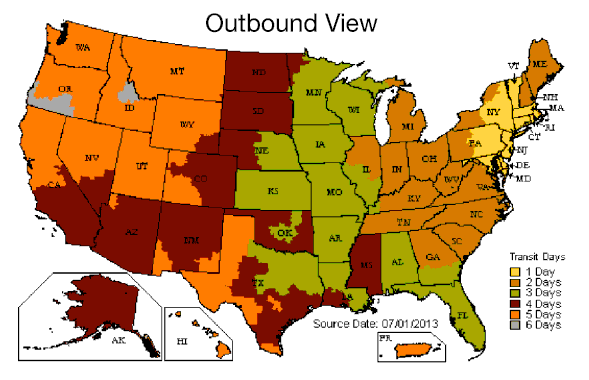
All other orders will usually ship the same day if the order is placed before 1pm EST. If your order is placed after 1pm EST, it will ship the next business day. ***For an additional charge a rush fee can be applied for same day shipping after 1pm EST.*** ***Shipping times are not guaranteed.*** After your order has been shipped, you will receive an email with a tracking number that will allow you to track the shipping progress of your order. The delivery time depends on the location where the products are being shipped.
How do I track my order?
You will then be able to track your order by going to https://www.fedex.com/en-us/home.html
What is your return/exchange policy?
Due to the fact that our products are food industry related we do not accept returns or exchanges for opened products. BioandChic accepts returns on all unopened / unused merchandise within 30 days of purchase. There is a 25% restocking fee on all returns.
If you need to make a return please click here or e-mail support@bioandchic.com
Where are the products made?
Due to the variety of materials and designs, our products are manufactured in different countries around the world (Europe, Asia, USA, and Africa).
Do you do customize or create custom products? What is the procedure?
We do. Please email support@bioandchic.com for more information about minimum order and quote.
What can I do if I forgot my password?
It is very easy to reset your password. You just have to click https://bioandchic.com/login.php?action=reset_password and enter the e-mail address associated with your BioandChic account. You will then receive an e-mail in the next 5 minutes with instructions for resetting your password. If you don't receive this e-mail, please check your junk mail folder or contact us for further assistance.
Are cardboard and paper compostable?
Are sugarcane products compostable?
Molded pulp products are compostable if they are made of vegetable residues and without any chemical additive. In this case they are in accordance to the EN 13432 norm.
Are wooden packaging's compostable?
By definition, wood is compostable and biodegradable when it is completely natural. It is in accordance to the EN 13432 norm. However, wooden products are oftenly associated with plastic, paper, glue or inks. In this case, it would not be a 100% compostable product. Wood is also easily recyclable, it can be transformed into chips and it can be used once again.
What are the PEFC and FSC certifications?
These are forestry certifications concerning the sustainable management of forests. They guarantee an eco-aware management. This certification is very common among European and North American forests.
What does biodegradable mean?
A biodegradable product is the one that can be easily decomposed by microorganisms without adding any chemical product. Time for biodegradability will depend on the amount of oxygen, humidity rate and temperature.
What is the composting process?
It is a natural biological process that gives value to organic matters and allows its conversion into a high humic product when in the presence of oxygen. At the end of the composting process, we get compost or humus which can be directly used in agriculture. By composting, we avoid costly and polluting incinerations and we give value to our wastes.
What is the difference between a recyclable product and a recycled product?
A recycled product is fully or partially made of waste. The most common recycled product is the glass or the recycled paper, made of paper waste. A recyclable product can be reused by recycling or by industrial processing.